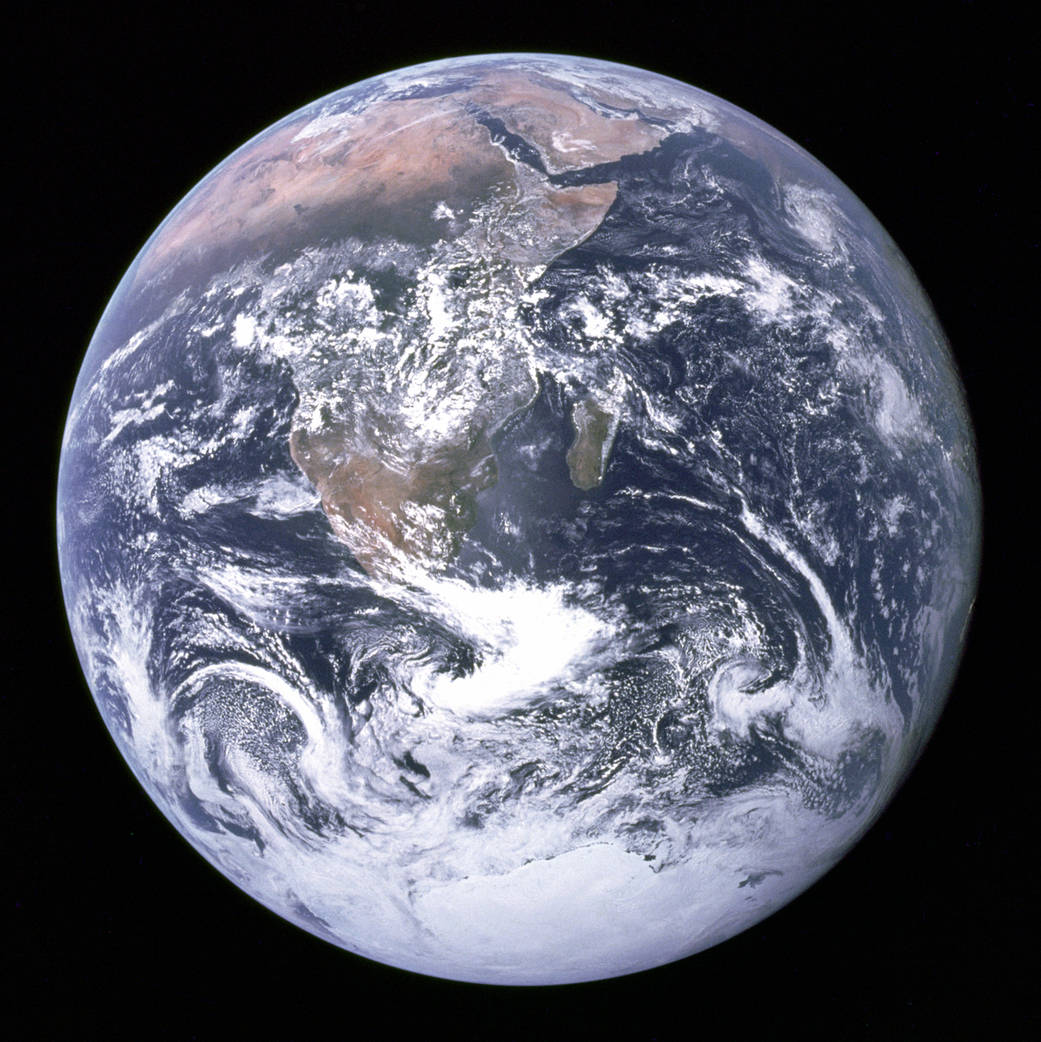
Earth From Space Apollo 17 Dec. 1972
| Home | Energy Physics | Nuclear Power | Electricity | Climate Change | Lighting Control | Contacts | Links |
|---|
DEFINITIONS:
Local Albedo
= (average solar radiation power per unit area reflected into space) / (average incident solar radiation power per unit area)
at any particular location on the Earth's surface.
Earth's Planetary Bond Albedo Fr
= (average solar radiation power reflected into space from the whole Earth) / (average solar radiation power incident on the whole Earth)
Solar Irradiance Ho
= solar radiation power per unit area at the Earth's orbit
= 1365 W / m^2
SOLAR POWER ABSORBED BY CROSS SECTIONAL AREA Ac:
Let Ac be Earth's cross sectional area normal to the solar flux Ho.
The solar power absorbed by cross sectional area Ac of an ideal black body located in the Earth's orbit is:
Ho Ac
A real body, such as the Earth, reflects fraction Fr of the solar power incident upon it. Hence the solar power absorbed by cross sectional area Ac is:
Ho (1 - Fr) Ac
A portion of albedo is Rayleigh scattering by ozone molecules in the atmosphere. Rayleigh scattering is dominant at the high frequency end of the visible spectrum and gives the sky its apparent blue color. Rayleigh scattering continues on into the ultra-violet frequency range.
When the sky is overcast by cloud the larger particle sizes of ice microcrystals or water droplets in the cloud cause Mie scattering to dominate. Mie scattering is not strongly wavelength dependent, so clouds usually appear white or grey.
Clouds reflect back into space a large portion of the solar light incident upon them. The local albedo of a cloud is generally in the range .36 to .56
Local albedo is a also function of ground cover (snow, ice, water, trees, grass, sand, etc.). Typical local albedos for open sky conditions are tabulated below:
| GROUND COVER | LOCAL ALBEDO |
|---|---|
| Open Ocean | .035 |
| Charcoal | .04 |
| Smooth Standing Water | .07 - .08 |
| Pine Forest | .09 |
| Swampland | .09 - .14 |
| Deciduous Trees | .13 |
| Grassy Fields | .20 |
| Sand | .25 |
| Ice | .3 - .4 |
| Old Snow | .4 - .7 |
| Fresh Snow | .7 - .9 |
The local albedo of flat open water is also affected by the angle of incidence of the solar radiation.
Note that when there is no cloud the local albedo of the open ocean for overhead solar illumination at .035 is extremely low. When floating ocean ice melts there is a large change in local albedo. A decrease in local albedo due to melting of snow or ice has the effect of increasing absorbed solar energy, and vice versa. Even if the change in local albedo is moderated by low angle solar illumination and/or partial cloud cover, the change in local albedo due to the liquid-solid phase transition of water is still large.
Note that the local albedo of ice and snow varies over a wide range. Part of this local albedo change is caused by deposition of microscopic soot particles. The poster Black Carbon in Arctic Snow and its Effect on Surface Albedo shows that black carbon dust particle mass concentrations of less than 10^-6 of ice and snow mass substantially reduce the local albedo. The main source of this soot is combustion of fossil fuels.
TEMPERATURE DEPENDENCE OF LOCAL ALBEDO:
In qualitative terms the local albedo is high over snow, ice or white clouds (composed of microscopic ice crystals), is moderate over dry land and grey cloud (composed of water droplets) and is low over the ocean. There is a step decrease in local albedo as the local ground level temperature rises from below the freezing point of water to above the freezing point of water. There is another step decrease in local albedo as the cloud temperature rises from below the freezing point of water to above the freezing point of water. This issue is vividly demonstrated on the following photo of the Earth from space.
EARTH AS VIEWED FROM OUTER SPACE VIA REFLECTED SOLAR ILLUMINATION:
Earth From Space Apollo 17 Dec. 1972
This photograph of Earth taken from near the moon during the Apollo moon landing program shows that during the early 1970s: near Earth's equator the average local Bond albedo was about 0.10, near Earth's poles the average local albedo was about 0.50, and for the whole Earth the average albedo was about 0.30. This data indicates that as heat accumulation from global warming melts ice the planetary Bond albedo of Earth will decrease from about 0.30 to about 0.10. This decrease in planetary Bond albedo will cause a spontaneous average temperature rise known as atmospheric thermal runaway.
Satellite measured changes in Arctic albedo are discussed in the paper titled: Unraveling driving forces explaining significant reduction in satellite-inferred Arctic surface albedo since the 1980s. The important observation is that the total Arctic surface albedo declined at about 0.94% per decade from 1980 to 2014.
On most days in the Arctic the sky is not clear. If you look up during the day time you often see murky white. A major component of the satellite measured surface albedo is not snow or ice, it is lower atmosphere air borne ice crystals. The paper authors failed to recognize that simple fact. However, the measurement of a 0.94% per decade decline in satellite measured total surface albedo is extremely important. From that data it may be possible to quantify the status of thermal runaway. I believe that increased atmospheric CO2 concentration raises the lower atmosphere temperature sufficiently to reduce the airborne ice crystal content over the circumpolar countries. That reduction in atmospheric airborne ice crystal content reduces the satellite measured local albedo. That albedo reduction causes net planetary heating beyond that directly caused by atmospheric CO2.
EARTH's PLANETARY BOND ALBEDO
Earth's planetary Bond albedo is usually measured by measuring the intensity of Earthshine reflected off the moon as compared to sunshine reflected off the moon. The planetary Bond albedo is an average of many of local albedo values.
The best available value for the Earth's planetary Bond albedo Fr is from Earthshine observations of the earth's reflectance which give the Earth's planetary Bond albedo as:
Fr = .297 +/- .005
by photometric measurements of Earthshine reflected off the Moon conducted during the period late 1998 to early 2001. The report notes a slight decrease in the Earth's planetary Bond albedo as compared to a similar measurement made in the period 1994-1995. An ongoing decrease in the Earth's planetary Bond albedo is occurring due to ongoing melting of glaciers and floating ice near the north and south poles and due to warming of clouds in Earth's atmosphere.
As the average Earth emission temperature rises the local Bond albedo values decrease in two major steps. One step is related to melting of surface ice on both land and water. The other step is related to conversion of dominant clouds from ice particles to water droplets. The step behavior of the local bond albedo is of major importance in CO2 related climate change matters because this step behavior leads to the atmosphere having two stable temperature states, a "cool" state and a "warm" state.
In the "cool" state the ocean surface is frozen and the local Bond albedo is about 0.50.
In the normal "mixed" state such as we live in today Earth's planetary Bond albedo is about 0.29.
In the "warm" state the local Bond albedo is about 0.10.
Due to the length of time required to melt the polar icecaps it can be argued that from a planetary perspective between the "cool" state and the "warm" state there is a "mixed" state in which the Earth's planetary Bond albedo is about 0.30.
A transition from a planetary "cool" state to a planetary "warm" state can be triggered by an increase in the atmospheric CO2 concentration. Similarly a transition from a planetary "warm" state to a planetary "cool" state can be triggered by a decrease in atmospheric CO2 concentration. Note that the change in atmospheric CO2 concentration is only the trigger event. The state change is primarily the result of a change in Earth's planetary albedo. This state transition phenomena is discussed in detail on the web page titled THERMAL RUNAWAY.
BOND ALBEDO MEASUREMENT METHODOLOGY:
The Earthshine-Moonshine method of measuring Earth's Bond albedo is a ratio. The moon is not an ideal diffuse reflector. However, provided that the angle of incidence and angle of observation are the same for both Earthshine and Moonshine measurements the reflection non-idealites cancel out. However, all measurements must be made under clear atmosphere conditions. These various conditions taken together mean that a telescope with a highly linear solar intensity measurement apparatus must be dedicated to the Bond albedo measurement project over a two year period. Hence the measurement of Earth Bond albedo is not as simple as it may seem at first glance.
In practice the procedure is to acquire a lot of data, reject from that data all occurrences of cloud cover, and then select Earthshine-Moonshine data pairs corresponding to correct angular positions. There is a further correction for the moon's elliptical orbit.
Once suitable data pairs are identified they need to be averaged. To do the job properly the measurements must also be suitably frequency weighted.
Accurate measurement of Earth's Bond albedo is not a trivial project. It is a multi-year exercise for experienced astronomers with suitable dedicated equipment.
ALBEDO REFERENCES:
Effect of Cloud Feedback on Albedo by James Hansen et al
Black Carbon in Arctic Snow and its Effect on Surface Albedo
Earth's Bond Albedo as listed on a NASA fact sheet from 2004
Disk Averaged Earth's Reflectance Spectra
This web page last updated December 10, 2019
| Home | Energy Physics | Nuclear Power | Electricity | Climate Change | Lighting Control | Contacts | Links |
|---|